
Introduction
Picture this: robots taking over the world and humans heading towards a real-life 'Matrix' scenario. While that may seem like science fiction, the transformative power of artificial intelligence (AI) is very much a part of our current reality. Case in point: the surge of AI writing platforms, revolutionizing content creation across industries. These tools are reshaping how we communicate, making it easier than ever to produce compelling writing.
Designed to alleviate repetitive, time-consuming tasks, AI writing software streamlines the creation process by offering suggestions for improvement and rapidly generating text responses. Powered by advanced machine learning models, this state-of-the-art technology deciphers context, intent, and style, effortlessly producing vast amounts of usable content in seconds.
However, there's a caveat: while platforms like ChatCPT 3.5 excel at generating relevant outputs, their reliance on patterns and data can result in robotic and monotonous writing. AI detectors can easily pick up on these signs and expose AI writing. That's where undetectable AI models come in, infusing personality and charm into bland AI-generated writing.
Representing a new frontier in artificial intelligence, undetectable AI operates stealthily to evade traditional detection methods. Unlike conventional AI models, which leave behind digital footprints and recognizable patterns, undetectable AI leaves little trace of its machine origins. These cutting-edge AI systems excel at emulating human writing, making it difficult for AI detectors to distinguish their outputs from human norms.
Blurring the boundaries between human and machine agency, using undetectable AI models, leads to questions about accountability, transparency, and autonomy in the digital age. By replicating human writing styles, some argue that these platforms dilute the authenticity of written content and devalue the contributions of human authors. Despite the ethical considerations surrounding undetectable AI, these systems offer exciting prospects for enhancing creativity, accessibility, and inclusivity in content creation.
In this blog, we're taking a closer look at undetectable AI's unique capabilities, comparing them to human writers' skills and uncovering each's strengths and limitations. We'll also discuss some of the most pervasive myths surrounding undetectable AI, debunking misconceptions and setting the record straight. Keep reading to jump into our dive deep into undetectable AI and the ever-evolving AI landscape.
Man vs Machine – Who Comes Out on Top?
We've got a battle of technological advancement and societal impact in the ring; let's see how they duke it out.
AI writing has revolutionized the content creation landscape, and undetectable AI is leading the charge with its unparalleled capabilities. By harnessing the power of machine learning and natural language processing, undetectable AI tools like WriteHuman empower writers to produce high-quality content quickly. These tools save time and improve accuracy and consistency, delivering error-free content at scale. With undetectable AI, human writers can maintain a competitive edge in today's fast-paced digital world, engaging audiences with compelling content that drives results.
While AI writing offers undeniable efficiency gains, it's not immune to criticism and skepticism. The rise of undetectable AI, in particular, raises red flags about the authenticity and integrity of content. By closely mimicking human writing styles, undetectable AI tools may inadvertently lead to losing human creativity and ingenuity in the content creation process. On top of that, there's the looming threat of job displacement as AI automation threatens to replace specific roles traditionally held by human writers.
But we're not jumping to conclusions. As we explore the impact of undetectable AI on content creation, we'll assess whether it genuinely compromises authenticity or brings new dimensions to creativity. Scroll down to explore these concerns and see if they withstand scrutiny.
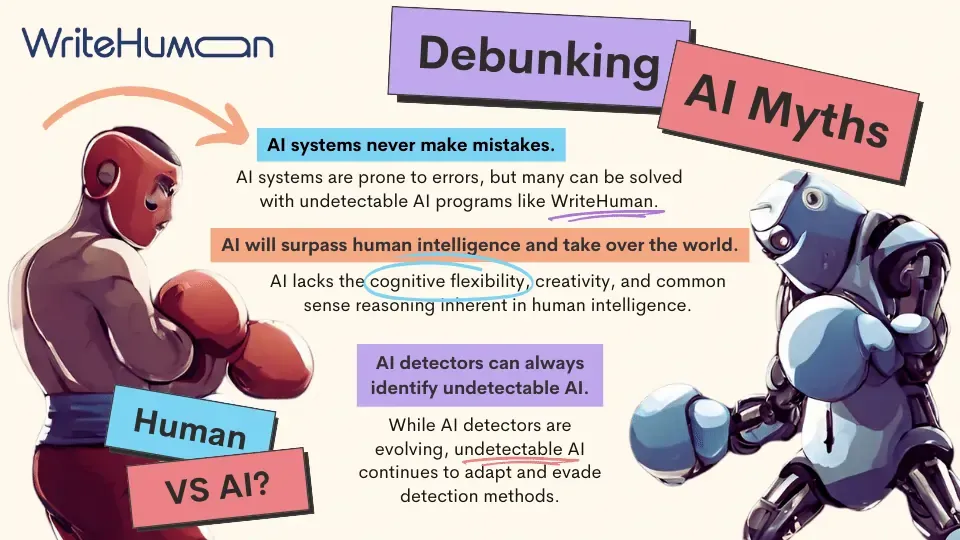
Fighting Common AI Myths
As undetectable AI tools gain prominence, so do the myths surrounding their capabilities. From claims that AI can replace human writers to concerns about undetectable AI ethics, we'll shed light on the reality of AI technology.
Myth: AI writing tools can replace human writers entirely.
Although AI writing tools can be beneficial, they can't be creative or intuitive or understand the complex context and emotions like humans do. They still have a long way to go before they can replace human writers.
Myth: AI writing tools always generate flawless content without errors.
AI writing tools may produce grammatical errors, inaccuracies, and awkward phrasing, particularly with complex language structures or niche topics. But WriteHuman's undetectable AI can flag and fix mistakes in real time, no matter the source material!
Myth: Undetectable AI is inherently unethical because it operates without accountability or oversight.
Although undetectable AI may pose challenges for oversight and accountability, its ethical implications depend on its use and potential consequences, not just its detectability.
Myth: Undetectable AI encourages a culture of dishonesty and undermines integrity.
To ensure integrity, undetectable AI should be guided by ethical principles and institutional policies that encourage originality, honesty, and responsible research practices in the settings where it is used.
Myth: AI detectors are foolproof and can easily identify all AI systems.
AI detectors have limitations, and there is always room for improvement. Sophisticated AI algorithms are constantly evolving to evade detection methods, which presents an opportunity for researchers to develop more advanced and effective detection techniques.
Myth: AI detectors will eventually render undetectable AI obsolete.
The ongoing cat-and-mouse game between undetectable AI and AI detectors will probably persist indefinitely, and both sides will keep innovating and adapting to outsmart each other. Instead of aiming for permanent dominance, this constant innovation and adaptation will lead to the development of more efficient and effective AI systems that can better serve humanity.
Calling for a Truce
When humans and machines team up, the possibilities are endless. WriteHuman is making this vision a reality. Their algorithm is not just focused on efficiency but also on doing things the right way. WriteHuman sets the bar for ethical content creation, with transparency, accountability, and integrity as guiding principles. It is even more exciting that their AI technology is virtually undetectable. With a built-in AI detector, WriteHuman ensures all content is genuine and reliable.
As we navigate the complexities of undetectable AI, let's remember that the true power lies in our ability to harness technology responsibly and ethically. With WriteHuman leading the charge, we're poised to embrace a future where humans and machines work together harmoniously to create content that informs, inspires, and empowers.
FAQs
Can AI writing tools replace human writers entirely?
While AI writing tools offer efficiency gains, they lack the creativity, intuition, and nuanced understanding of complex contexts and emotions that human writers possess. Thus, they're not yet capable of entirely replacing human writers.
Is undetectable AI inherently unethical due to lack of accountability and oversight?
The ethical implications of undetectable AI depend on its application and potential consequences, not solely its detectability. While it poses challenges for oversight, it can be used ethically with proper governance and adherence to ethical principles.
Does undetectable AI encourage dishonesty and undermine integrity?
To maintain integrity, undetectable AI should adhere to ethical principles and institutional policies promoting originality, honesty, and responsible research practices. Its usage should align with ethical standards to mitigate concerns about integrity.
Are AI detectors foolproof and capable of identifying all AI systems?
AI detectors have limitations and can be circumvented by sophisticated undetectable AI algorithms constantly evolving to evade detection methods. This ongoing cat-and-mouse game challenges researchers to develop more advanced detection techniques.