

Introduction
As AI writing takes over content creation, it is becoming increasingly important to find ways of making your content stand out. While AI writing tools offer convenience and efficiency, their output often lacks the natural flow and human touch that resonates with audiences. This is where the practice of humanizing AI text comes into play.
Humanizing AI text involves taking the robotic, stilted language produced by AI models and transforming it into content that sounds as if it were written by a human. This process is crucial for several reasons:
It helps bypass AI detectors like Originality.ai and Turnitin, which can penalize or filter out content identified as AI-generated.
It enhances engagement and trust, as human audiences tend to connect better with natural, conversational language.
It allows you to maintain a consistent brand voice and tone, even when leveraging AI writing assistance.
However, humanizing AI text is not without its challenges. AI language models often produce text that is overly formal, repetitive, and lacking in nuance. Sentences can be long-winded and awkward, devoid of the idiomatic expressions and personal touches that make writing relatable.
"The goal of humanizing AI text is to strike the perfect balance between the efficiency of AI writing and the authenticity of human expression." - Ivan Jackson, CEO, WriteHuman
This guide will walk you through practical, actionable steps to effectively humanize AI text, ensuring your content resonates with your target audience while maintaining the benefits of AI writing.
Table of Contents
What is AI Text Humanization?
AI text humanization is the process of taking machine-generated content and refining it to sound more natural, conversational, and human-like. It involves carefully editing and revising the language, phrasing, and structure of AI-written text to eliminate robotic qualities and imbue it with the nuances and idiosyncrasies of human expression.
The need for humanizing AI output arises from several factors:
Bypassing AI detectors: Services like Originality, Turnitin, and GPTZero are designed to identify AI-generated content, which can lead to penalties or outright rejection of your work. Humanizing AI text helps bypass these detection systems.
Human preference for natural language: Audiences have a strong preference for content that sounds genuinely human. AI-generated text, no matter how well-written, often lacks the natural flow and personal touch that resonates with readers.
By investing time and effort into humanizing AI text, you can reap numerous benefits:
Better engagement: Natural, conversational language is more engaging and easier to connect with, leading to higher readership and dwell times.
Increased trust: Human-like content fosters a sense of authenticity and builds trust with your audience, which is essential for establishing credibility and authority.
Improved conversions: Content that resonates on a personal level is more persuasive and effective at driving desired actions, such as making a purchase or signing up for a service.
Ultimately, AI text humanization is a crucial step in leveraging the power of AI writing while preserving the unique human element that sets great content apart.
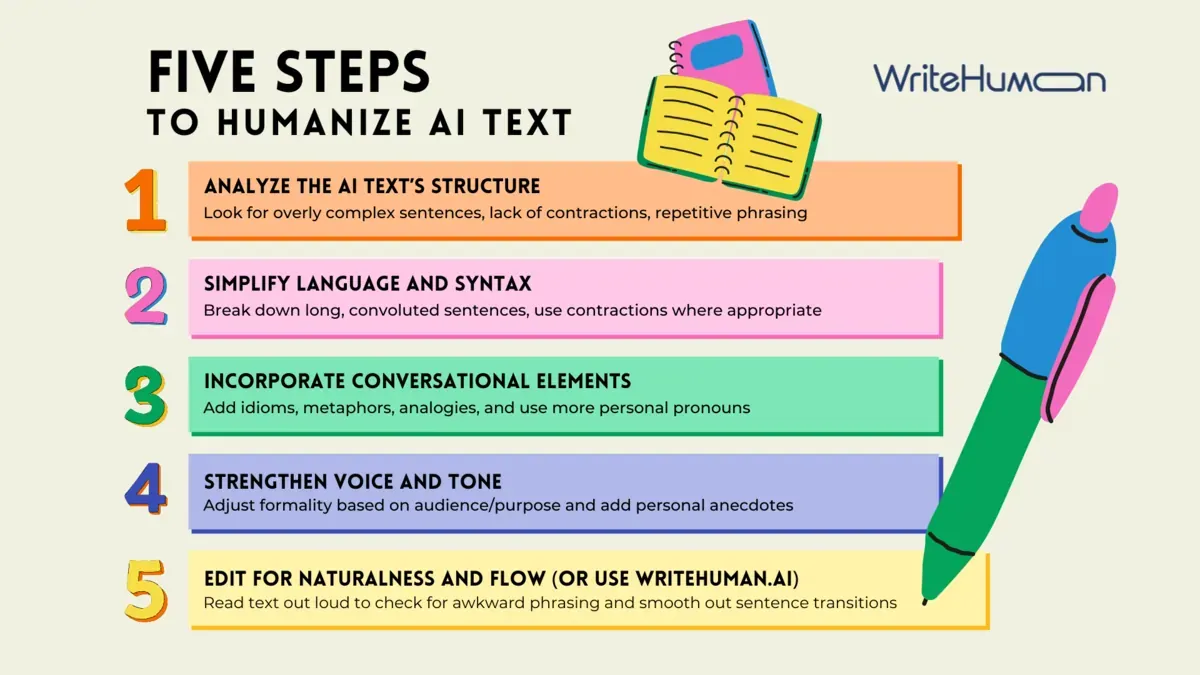
Step 1: Analyze the AI Text's Structure
The first step in humanizing AI text is to carefully analyze the structural elements that contribute to its robotic or unnatural quality. This involves critically evaluating the text for indicators of machine-generated content, such as:
Overly complex sentences: AI language models often produce unnecessarily long and convoluted sentences that are difficult for human readers to follow.
Lack of contractions: Contractions like "don't," "can't," and "it's" are common in natural human writing but frequently absent in AI-generated text.
Repetitive phrasing: AI models can sometimes fall into patterns of repeating the same words or phrases, resulting in a lack of varied language.
As you review the AI text, be on the lookout for these and other telltale signs that the content may have been machine-generated. Pay attention to areas that sound particularly robotic, stilted, or unnatural – these sections will likely require the most attention during the humanization process.
Some specific elements to watch for include:
Sentences that are excessively long or densely packed with information
Phrasing that feels overly formal or academic, lacking a conversational tone
Transitions between sentences or paragraphs that seem abrupt or disjointed
Overuse of passive voice or impersonal constructions
Lack of idiomatic expressions, metaphors, or other figurative language
By carefully analyzing the AI text's structure and identifying areas that sound unnatural or robotic, you'll be better equipped to target and refine those elements in the subsequent steps of the humanization process.
Step 2: Simplify Language and Syntax
Once you've identified the areas of the AI text that sound overly complex or unnatural, it's time to start simplifying the language and syntax. This step is crucial for making the content more readable and conversational, aligning it with how humans naturally communicate.
Break Down Long, Convoluted Sentences
AI language models often produce sentences that are unnecessarily long and densely packed with information. While these may be technically correct, they can be overwhelming and difficult for readers to follow. To humanize the text, break down these complex sentences into shorter, more digestible segments.
For example, consider this sentence from an AI model:
The process of optimizing a website for search engines, known as search engine optimization (SEO), involves a variety of techniques and strategies aimed at improving the visibility and ranking of a website's pages in search engine results, ultimately increasing the likelihood of attracting more organic traffic to the site.
This could be simplified into two or three more natural-sounding sentences:
Search engine optimization (SEO) helps improve a website's visibility on search engines. It involves various techniques to boost a site's ranking in search results. With higher rankings, websites can attract more organic traffic.
Use Contractions Where Appropriate
AI-generated text often lacks the use of contractions, which can make it sound overly formal and robotic. To humanize the language, strategically incorporate contractions like "don't," "can't," "it's," and "they're" where they would naturally occur in human speech or writing.
Vary Sentence Structures
Repetitive sentence structures can contribute to a monotonous, robotic tone. To add more natural variety, mix up the types of sentences you use, alternating between simple, compound, and complex structures. This will help create a more engaging and dynamic flow, mimicking the patterns of human communication.
By simplifying the language, using contractions, and varying sentence structures, you'll begin to transform the AI text into a more conversational and approachable form, setting the stage for further humanization in the following steps.
Step 3: Incorporate Natural Conversational Elements
Now that you've simplified the language and syntax, it's time to infuse the AI text with more natural, conversational elements that are characteristic of human communication. This step is crucial for making the content feel more relatable and engaging.
Add Idioms, Metaphors, and Analogies
Figurative language, such as idioms, metaphors, and analogies, is a hallmark of human expression. AI models often struggle to incorporate these elements, resulting in text that feels overly literal or robotic. By strategically adding these elements, you can breathe life and personality into the content.
For example, consider this straightforward sentence from an AI model:
The company's sales have increased significantly in recent years.
You could humanize it by incorporating an idiom or metaphor, such as:
The company's sales have been on a rocket ship, soaring to new heights in recent years.
Use More Personal Pronouns
AI-generated text often lacks a personal touch, relying heavily on third-person or passive constructions. To create a more conversational tone, incorporate more personal pronouns like "I," "you," and "we." This simple change can make the content feel more directly engaging and relatable.
For instance, instead of:
It is recommended to prioritize high-quality content for search engine optimization.
Try:
If you want to succeed at SEO, prioritizing high-quality content is the way to go.
Include Rhetorical Questions
Rhetorical questions are a powerful tool for drawing readers in and fostering a sense of dialogue. By incorporating these questions throughout the text, you can create a more interactive and engaging experience for your audience.
For example:
Have you ever wondered why some websites seem to dominate the search engine results? The secret lies in mastering the art of SEO.
By adding conversational elements like these, you'll transform the AI text from a one-dimensional monologue into a dynamic, human-like narrative that resonates with readers on a deeper level.
Step 4: Strengthen Voice and Tone
At this point, you've simplified the language, incorporated conversational elements, and begun to transform the AI text into something more natural and engaging. However, to truly humanize the content, you'll need to infuse it with a distinct voice and tone that aligns with your intended audience and purpose.
Adjust Formality Based on Audience/Purpose
The level of formality in your writing should be tailored to your target audience and the context in which the content will be consumed. For example, a blog post aimed at a general audience might call for a more casual, conversational tone, while technical documentation for professionals might require a more formal approach.
Analyze the AI text and make adjustments to the language, phrasing, and style to match the appropriate level of formality. This could involve incorporating more colloquial expressions or slang for a casual tone, or opting for more precise, technical terminology for a formal tone.
Convey Emotion Through Careful Word Choice
One of the hallmarks of human communication is the ability to convey emotion through language. AI models often struggle with this nuance, producing text that feels flat and emotionally detached. To humanize the content, carefully choose words and phrases that evoke specific emotions or set the desired emotional tone.
For instance, consider these two sentences describing the same event:
The company experienced a decline in sales last quarter.
Last quarter's sales figures were a disappointing blow, leaving the company reeling and searching for answers.
The second example uses more emotionally charged language to convey a sense of disappointment and urgency, making it feel more human and relatable.
Add Personal Anecdotes/Storytelling Elements
Personal stories and anecdotes are powerful tools for humanizing content and fostering a deeper connection with your audience. Consider sprinkling in relevant personal experiences or narratives that support the main points of the AI text.
For example, in a blog post about productivity tips, you could include a short anecdote about a time when you struggled with procrastination and how a particular strategy helped you overcome it. These personal touches not only make the content more relatable but also reinforce your expertise and authority on the subject matter.
By carefully adjusting the formality, evoking emotion through word choice, and incorporating personal stories, you'll infuse the AI text with a distinct voice and tone that resonates with your intended audience and purpose.
Step 5: Edit for Naturalness and Flow
After completing the previous steps, you've transformed the AI-generated text into something much more human-like and engaging. However, there's still an important final step to ensure a truly natural and seamless reading experience.
Read Text Out Loud to Check for Awkward Phrasing
One of the best ways to identify unnatural or awkward phrasing is to read the text out loud. By doing so, you'll be able to pick up on any clunky or stilted language that may have slipped through the previous editing stages.
As you read, pay attention to any sentences or phrases that feel uncomfortable or unnatural to say out loud. These are likely areas that could benefit from further refinement or rewording to better align with how humans naturally communicate.
Make Transitions Smooth Between Sentences/Paragraphs
Smooth transitions are essential for maintaining a natural, cohesive flow throughout the text. AI models can sometimes struggle with maintaining logical connections between ideas, leading to abrupt shifts or disjointed transitions.
Review the content carefully, ensuring that each sentence and paragraph logically follows from the previous one. If necessary, add transition words or phrases (e.g., "furthermore," "in addition," "however") to create a more seamless and natural progression of thoughts.
Fine-tune Vocabulary for Consistent Voice
Maintaining a consistent voice is crucial for creating a sense of authenticity and ensuring that the content feels like it was written by a single, human author. During the editing process, pay close attention to the vocabulary and word choices used throughout the text.
If you notice any jarring shifts in language style or tone, make adjustments to align with the overall voice you've established. This could involve replacing overly formal or technical words with more conversational alternatives, or vice versa, depending on the desired tone.
Additionally, be mindful of any inconsistent or mixed use of idioms, metaphors, or other figurative language. Ensure that these elements are used cohesively and consistently throughout the content to reinforce the desired voice and tone.
By reading the text out loud, smoothing transitions, and fine-tuning vocabulary for a consistent voice, you'll put the final polish on your humanized AI content, ensuring a truly natural and engaging reading experience for your audience.
Tools to Humanize AI Text
While the process of humanizing AI text can be time-consuming, there are tools available that can streamline and assist with the process. One such tool is WriteHuman, a platform designed specifically for refining and humanizing machine-generated content.
WriteHuman leverages advanced natural language processing models to analyze and transform AI text, implementing many of the techniques outlined in this guide. From simplifying language and varying sentence structures to incorporating idiomatic expressions and adjusting tone, WriteHuman automates several key steps in the humanization process.
While tools like WriteHuman can be invaluable in streamlining the humanization process, it's important to note that they should be used as aids, not replacements for human editing and oversight. The final product should always be carefully reviewed and refined to ensure a natural, cohesive, and consistently human-like voice throughout.
Conclusion
In today's AI-driven world, the ability to humanize machine-generated text is an invaluable skill. By following the practical steps outlined in this guide, you can transform robotic, AI-generated content into engaging, natural-sounding prose that resonates with human audiences.
Let's quickly recap the key steps for effective AI text humanization:
Analyze the AI text's structure, identifying areas that sound overly complex, lack contractions, or exhibit repetitive phrasing.
Simplify the language and syntax by breaking down long sentences, using contractions, and varying sentence structures.
Incorporate natural conversational elements, such as idioms, metaphors, personal pronouns, and rhetorical questions.
Strengthen the voice and tone by adjusting formality, evoking emotion through word choice, and adding personal anecdotes or storytelling elements.
Edit for naturalness and flow, reading aloud to catch awkward phrasing, smoothing transitions, and fine-tuning vocabulary for a consistent voice.
It's important to remember that humanizing AI text is an iterative process that takes practice and refinement. As you gain more experience, you'll develop a keener eye for identifying and addressing the nuances that separate robotic, machine-generated content from truly human-like writing.
Ultimately, the importance of humanizing AI content cannot be overstated. In an increasingly digital world, where audiences crave authenticity and human connection, AI-generated text that sounds robotic or artificial can quickly disengage readers and undermine trust in your brand.
By embracing the techniques of AI text humanization, you can harness the power and efficiency of AI writing while preserving the essential human element that makes content truly resonate. It's a critical skill for writers, marketers, and content creators of all kinds – one that will only become more valuable as AI continues to reshape the landscape of communication and content creation.
So embrace the art of humanizing AI text, and unlock the full potential of your AI-assisted content to inform, engage, and connect with your audience on a deeper, more authentic level.
Frequently Asked Questions
Why is it important to humanize AI-generated text?
Humanizing AI text is crucial for several reasons:
It helps bypass AI detection systems that can penalize or filter out machine-generated content.
Human audiences tend to engage better with natural, conversational language that feels authentic and relatable.
It allows you to maintain a consistent brand voice and tone, even when leveraging AI writing assistance.
What are some common issues with AI-generated text that require humanization?
Some common issues that can make AI text sound robotic or unnatural include:
Overly complex sentences and lack of contractions
Repetitive phrasing and lack of varied language
Absence of idioms, metaphors, and other figurative language
Formal or academic tone lacking a conversational quality
Lack of personal pronouns and emotional language
Can AI text humanization tools completely replace human editing?
While AI text humanization tools like WriteHuman can be incredibly helpful in streamlining the process, they should be used as aids rather than replacements for human editing and oversight. The final product should always be carefully reviewed and refined by a human to ensure a natural, cohesive, and consistently human-like voice throughout.
How long does it take to effectively humanize AI-generated text?
The time required to humanize AI text can vary depending on the length and complexity of the content, as well as your level of experience with the process. In general, expect it to take longer than simply generating the initial AI text, but the investment is worthwhile to create truly engaging, human-centric content.
Can AI text humanization improve search engine optimization (SEO)?
Yes, humanizing AI text can potentially improve your SEO efforts. By making your content sound more natural and human-like, you can enhance engagement metrics like dwell time and bounce rate, which are factors that search engines consider when ranking pages.